 Admin
Admin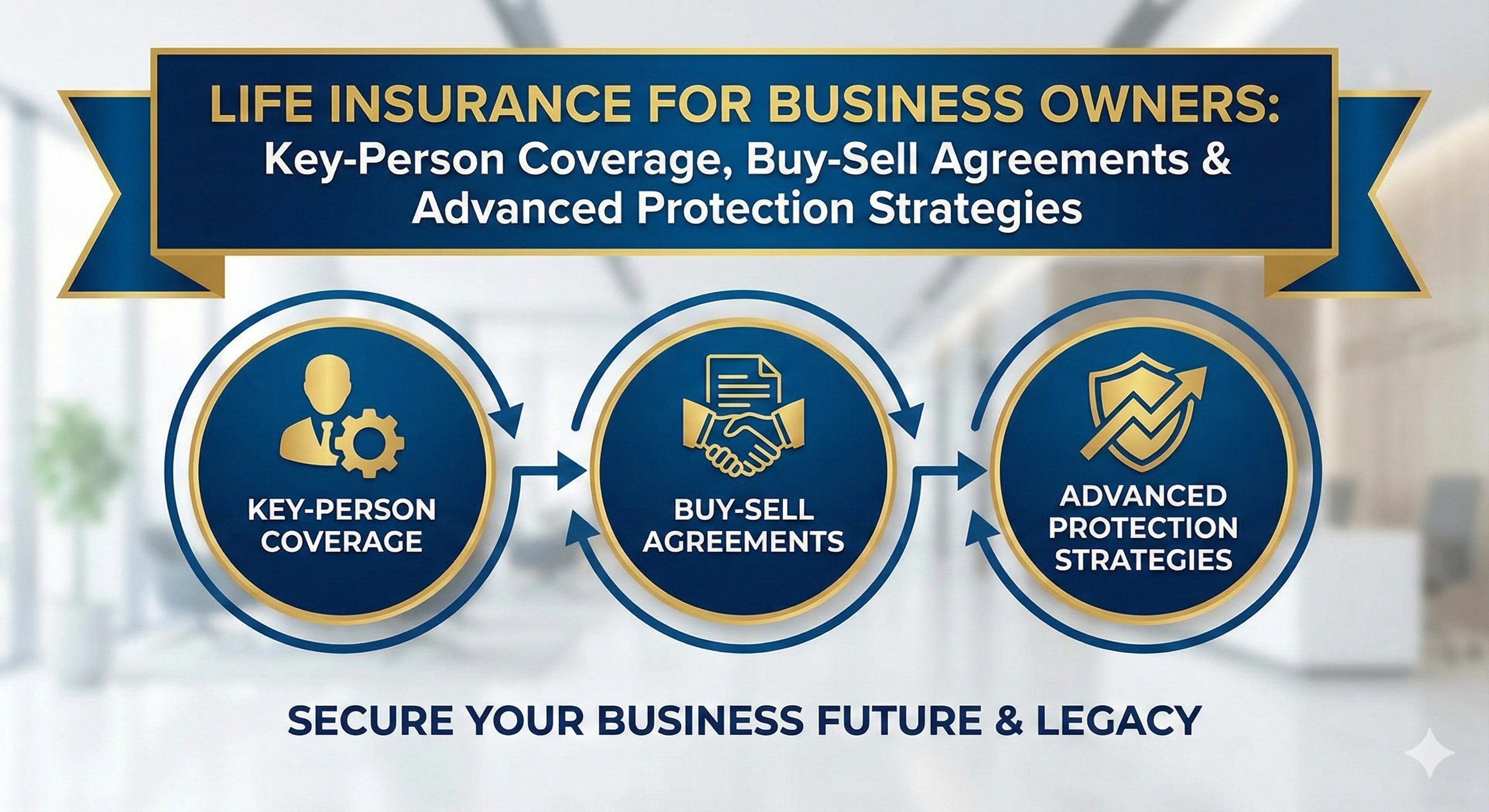
Life Insurance for Business Owners: Key-Person Coverage, Buy-Sell Agreements & Advanced Protection Strategies (2025 Guide)
Life insurance is not only a tool for personal financial protection—it is one of the most powerful mechanisms for protecting a business against unexpected losses, ownership disruptions, revenue interruptions, and long-term financial risks. Whether you run a small company, a fast-growing startup, or a large corporation, life insurance allows business owners to safeguard their operations, maintain continuity, protect key employees, and create a secure succession plan.
This comprehensive guide provides an in-depth look at how business owners should use life insurance in 2025 including key-person coverage, buy-sell agreement funding, executive compensation strategies, taxation, global best practices, underwriting requirements, and policy types most suitable for businesses. This resource is designed for founders, directors, entrepreneurs, corporate boards, financial consultants, and commercial insurance decision-makers.
1. Why Life Insurance Is Critical for Business Owners
Business owners face unique risks compared to standard employees or households. In most cases, the survival of the company depends on a few key people—the founder, executives, top sales producers, or partners. If one of them passes away unexpectedly, the financial damage can be severe:
- Loss of revenue tied to the key person
- Loss of leadership, client relationships, and expertise
- Loan defaults if the individual guaranteed business debt
- Investor withdrawals or loss of confidence
- Difficulty finding replacement talent
- Legal disputes between partners or heirs
- Operational disruption and reduced company valuation
Life insurance solves these problems by providing immediate liquidity. This allows the company to stay financially stable while navigating the transition. In 2025, insurers have made it easier than ever for businesses to obtain corporate policies without invasive requirements or long approval cycles.
2. What Is Key-Person Insurance?
Key-person insurance (also known as key-man or key-woman insurance) is a life insurance policy purchased by a business on the life of one of its essential employees or owners. The company is the policy owner, premium payer, and beneficiary. If the covered employee dies, the business receives a tax-free lump sum payout.
2.1 Who Qualifies as a Key Person?
Any individual whose loss would significantly impact the company’s financial health qualifies as a key person. Examples include:
- CEOs and founders
- Business partners
- Top sales executives
- Product creators and technical specialists
- Financial controllers or CFOs
- Employees with unique expertise or client relationships
The death of one of these individuals can cause long-lasting damage. Key-person insurance creates a financial buffer to sustain operations and hire replacements.
2.2 What Does Key-Person Insurance Cover?
- Loss of revenue tied to the key person
- Cost of recruiting and training a replacement
- Loss of business opportunities
- Payout to investors or lenders to maintain confidence
- Debt protection if the key person was a guarantor
- Operational expenses while the business reorganizes
2.3 How Much Key-Person Insurance Does a Business Need?
The coverage amount varies but common valuation approaches include:
- Revenue Method: 5–10× the revenue the key person generates.
- Profit Contribution Method: A multiple of the profit directly attributed to their work.
- Cost-to-Recruit Method: Cost to replace the individual + estimated losses during transition.
- Company Valuation Method: Percentage of business value at risk.
Most insurers offer coverage starting from USD $250,000 up to $50 million+ for large corporations.
3. Buy-Sell Agreements: The Most Important Insurance Tool for Multi-Owner Businesses
A buy-sell agreement is a legally binding contract that determines what happens to ownership if a partner dies, becomes disabled, retires, or exits the business. The most common funding method for buy-sell agreements is life insurance, because it provides guaranteed liquidity at the exact moment it is needed.
3.1 Why Buy-Sell Agreements Are Critical
Without a buy-sell agreement, the death of a business partner can cause:
- Conflict with heirs or surviving family members
- Disputes over valuation
- Forced sale of the business
- Loss of operational control
- Financial instability
Life insurance ensures the remaining partners can purchase the deceased partner’s share smoothly—preventing chaos, lawsuits, and business collapse.
3.2 Types of Buy-Sell Agreements
Cross-Purchase Agreement
Each partner takes out a life insurance policy on every other partner. Common for small businesses with 2–3 owners.
Entity Purchase (Stock Redemption) Agreement
The business itself buys back the deceased partner’s shares. Simplifies administration for companies with many partners.
Wait-and-See Agreement
Flexible hybrid model allowing business owners to choose which method is best at the time of triggering event.
3.3 How Life Insurance Funds a Buy-Sell Agreement
- A life insurance policy is taken out on each partner.
- The business or partners pay premiums.
- If a partner dies, the payout goes to the purchasing entity.
- The funds are used to buy the deceased owner’s share from their heirs.
This ensures stability, control, and uninterrupted operations.
4. Types of Life Insurance Suitable for Business Owners
Business owners have access to several policy types depending on goals, budgets, and protection needs.
4.1 Term Life Insurance
Affordable, simple, and ideal for:
- Key-person coverage
- Buy-sell agreements
- Loan protection
- Short-term business needs
Policies typically offer high coverage at low cost—good for fast-growing startups or small businesses.
4.2 Whole Life Insurance (Permanent Coverage)
Offers lifetime protection plus cash value. Useful for:
- Long-term buy-sell agreements
- Executive benefits
- Tax-efficient wealth transfer
- Corporate-owned life insurance (COLI)
4.3 Universal Life (UL & IUL)
Flexible premiums, long-term accumulation, interest-sensitive growth. Often used in:
- Complex business succession planning
- Retirement planning for owners
- Building corporate cash reserves
- Funding executive compensation
5. Business Uses for Life Insurance in 2025
5.1 Business Continuity and Succession Planning
Life insurance ensures smooth transition of management, ownership, and finances.
5.2 Collateral for Business Loans
Many lenders require life insurance for loans involving:
- Startups
- Real estate purchases
- Commercial expansion
- Private investor agreements
5.3 Executive Bonus Plans (IRC 162 Plans)
Companies use life insurance as a tax-deductible bonus to retain top talent.
5.4 Split-Dollar Agreements
Employer and employee share costs and benefits—popular for high-income executives.
5.5 Corporate-Owned Life Insurance (COLI)
Used to insure multiple executives, accumulate cash value, and support long-term obligations.
6. Tax Advantages for Business Owners (Global Overview)
Although tax rules differ by country, some global principles apply:
- Death benefits are generally tax-free.
- Premiums for key-person insurance may be tax-deductible (varies by jurisdiction).
- Cash value in permanent policies grows tax-deferred.
- Buy-sell agreements may offer favorable tax treatment for both parties.
- Policy loans may be tax-free when structured correctly.
Business owners should consult tax advisors for country-specific rules.
7. Global Underwriting Requirements in 2025
Most insurers require:
- Business financial statements
- Company valuation
- Salary documentation for key individuals
- Proof of insurable interest
- Medical underwriting (though simplified issue options exist)
Technology-driven insurers now use AI to accelerate approvals within 24–72 hours for many corporate policies.
8. How to Choose the Right Life Insurance Strategy as a Business Owner
- Map out succession risks. Identify individuals whose loss would impact operations.
- Determine business valuation. Needed for buy-sell funding.
- Select policy types. Term for affordability; permanent for long-term strategic benefits.
- Formalize legal agreements. Work with attorneys to structure buy-sell contracts.
- Review regularly. Update coverage as revenue, ownership, or leadership changes.
9. Conclusion: Life Insurance Is a Strategic Asset for Business Protection
In 2025, life insurance for business owners is more than a financial safeguard—it is a strategic tool for growth, continuity, investor trust, and long-term enterprise stability. Whether you're protecting a startup, family business, partnership, or corporation, the right insurance structure ensures your company survives and thrives even in the face of unexpected loss.
From key-person insurance to buy-sell funding, executive benefits, and tax-efficient planning, businesses worldwide rely on life insurance as an essential part of their operational foundation.
If you're a founder, entrepreneur, or business executive, now is the best time to review your protection strategy and ensure your company is prepared for the future.

 Admin
Admin