 Admin
Admin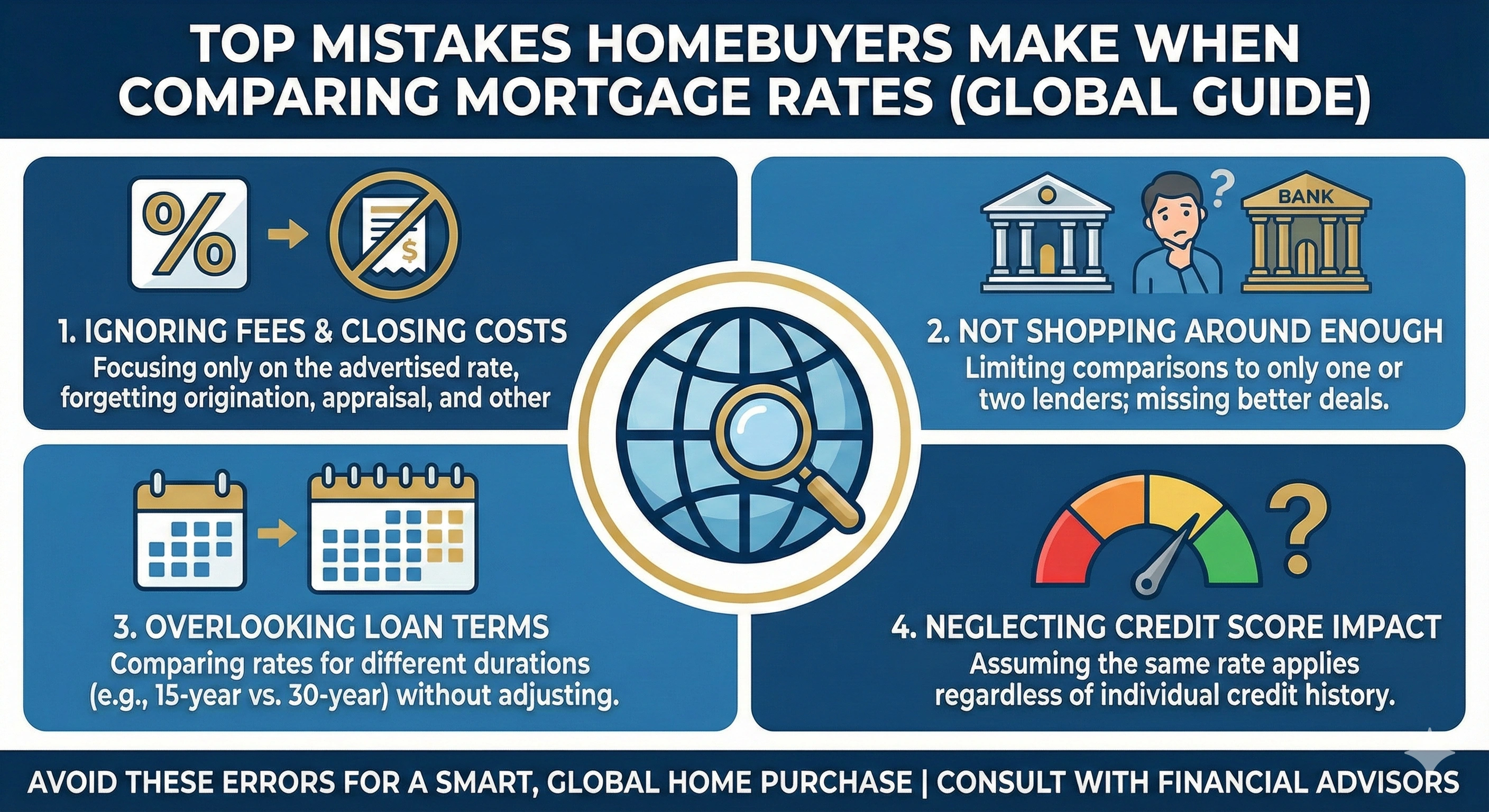
Top Mistakes Homebuyers Make When Comparing Mortgage Rates (Global Guide)
Buying a home is one of the biggest financial decisions in life, and securing the best mortgage rate can save you tens of thousands of dollars over the loan’s lifetime. Yet most homebuyers—whether in the U.S., Canada, Europe, India, Australia, or anywhere globally—make the same costly mistakes when comparing rates.
This comprehensive guide breaks down the 11 most common mortgage comparison mistakes and shows you exactly how to avoid them so you can secure the lowest possible rate and the best long-term value.
Why Comparing Mortgage Rates Is So Confusing
Most homebuyers assume mortgage comparison is simple. Just find the lowest interest rate, right? Not exactly.
Lenders use different terminology, fee structures, promotional discounts, and qualification criteria that can dramatically change the actual cost of a mortgage—even if the interest rate looks low.
This global guide explains the mistakes that almost every first-time and even experienced homebuyer makes, and how to avoid overpaying for your mortgage.
1. Focusing Only on the Interest Rate, Not the APR
The most common mistake is looking only at the advertised interest rate and ignoring the APR (Annual Percentage Rate).
Interest rate = cost of borrowing the money.
APR = interest rate + lender fees + mortgage insurance + closing costs + other mandatory charges.
APR gives the real cost of the loan.
Example:
- Lender A: 5.2% interest rate, but high fees → APR 6.0%
- Lender B: 5.4% interest rate, low fees → APR 5.5%
Winner: Lender B — even though the interest rate is higher.
Most homebuyers lose thousands by choosing the lowest rate instead of the lowest APR.
2. Not Comparing Lender Fees
Many lenders make money through fees, not the rate.
Common fees homebuyers ignore include:
- Origination fee
- Underwriting fee
- Processing fee
- Application fee
- Rate-lock fee
- Broker commission
- Loan creation or settlement fee (varies by country)
A lender offering a low rate might charge thousands in extra fees that make the total loan more expensive.
RULE: Always ask for a fee sheet or loan estimate before deciding.
3. Not Shopping Around with at Least 3–5 Lenders
Studies worldwide show that mortgage buyers who compare rates from at least 4 lenders save the most money.
Yet more than 60% of homebuyers accept the first quote they get.
Why this is a mistake:
- Lenders have different pricing models.
- Banks and credit unions often offer different terms.
- Brokered loans may include extra commissions.
- Online lenders often have lower overhead and can offer better deals.
Never take the first offer. Compare multiple lenders, even if you trust your bank.
4. Not Understanding Fixed vs Variable Rates
Homebuyers often choose the wrong type of loan because they only focus on the rate—not how it behaves over time.
Fixed Rate
The rate stays the same for the entire loan term. Best when interest rates are rising or volatile.
Variable/Adjustable Rate
The rate changes periodically based on market conditions. Lower starting rate, but risky long-term.
Common mistake:
Choosing a low variable rate in a rising-rate market.
This can cause monthly payments to increase drastically.
5. Ignoring Credit Score Requirements
Mortgage rates differ based on your credit score (or equivalent credit assessment in non-credit-scoring countries).
Example (general global pattern):
- Excellent credit → best interest rates
- Fair credit → higher interest rates
- Poor credit → much higher interest rates + extra requirements
Many homebuyers compare rates online but don’t know that the actual rate offered will be based on their creditworthiness.
Real mistake: Comparing theoretical rates, not the ones you actually qualify for.
6. Not Checking the Loan Term (15-Year vs 30-Year)
The mortgage length can dramatically change the rate.
Common loan terms worldwide:
- 15-year mortgage
- 20-year mortgage
- 25-year mortgage
- 30-year mortgage
Shorter loans → lower interest rates, but higher monthly payments.
Longer loans → higher rates, but lower monthly payments.
Big mistake: Homebuyers comparing rates across different loan terms without realizing it.
7. Forgetting About Mortgage Insurance
Mortgage insurance can significantly increase the total loan cost.
Types vary depending on country:
- PMI (Private Mortgage Insurance)
- LMI (Lender's Mortgage Insurance)
- Mandatory insurance for low down payments
- Government-backed loan insurance (e.g., VA/FHA equivalents)
Many buyers compare rates without including insurance costs—leading to an inaccurate comparison.
8. Falling for Introductory or Promotional Rates
Some lenders offer a low “teaser rate” for the first few months or years.
After that, the rate increases—often significantly.
Example:
- 1.99% for first year
- Then 6.99% for the remaining 24 years
Trap: Buyers compare the initial rate instead of the long-term cost.
Always check the comparison rate (Australia), the APR (U.S.), or equivalent in other markets.
9. Not Comparing Rate Lock Periods
Mortgage rates change daily.
A common mistake is accepting a quote that expires within a short time (e.g., 7 days).
If rates increase, your mortgage becomes more expensive before closing.
Always ask:
- How long is this rate valid?
- Is there a fee to lock the rate?
- Can I extend the lock?
10. Forgetting About Prepayment Penalties
Some lenders charge fees for paying off your mortgage early.
This can apply to:
- Refinancing
- Selling your home
- Making extra payments
Many buyers compare only the rate and forget to check whether the loan includes a prepayment penalty—potentially costing thousands later.
11. Not Considering the Total Cost Over the Loan Lifetime
The best way to compare mortgages is to look at the total cost over the full term:
Total mortgage cost = monthly payment × total months + fees + insurance
Most buyers compare only monthly payments, ignoring lifetime cost.
Example:
- Lower monthly payment but higher fees → more expensive long-term
- Higher monthly payment but lower APR → cheaper overall
How to Properly Compare Mortgage Rates (Step-by-Step Method)
Follow this simple process to avoid mistakes:
- Request quotes from at least 3–5 lenders.
- Compare APR—not interest rate.
- Check fees and insurance requirements.
- Use the same loan type and term across lenders.
- Check if the rate is fixed, variable, or hybrid.
- Ask about promotions, rate locks, and penalties.
- Calculate total lifetime cost.
- Verify the rate based on your actual credit profile.
Global Differences to Be Aware Of
Mortgage systems differ worldwide. Examples:
- U.S. and Canada → credit score heavily affects rates
- UK → lenders emphasize affordability checks
- Australia → comparison rate must be disclosed
- EU → many countries use variable-rate dominant systems
- India → fixed/variable hybrid loans are common
Regardless of region, the mistakes remain the same—and avoiding them leads to better financial outcomes for homebuyers.
Final Thoughts
Comparing mortgage rates is not as simple as looking at the lowest advertised interest rate. APR, fees, loan terms, insurance, credit score, and long-term costs all affect how much you ultimately pay.
By avoiding these 11 common mistakes, you can save thousands, secure a better mortgage, and make the smartest financial decision for your future.
FAQs
1. How many lenders should I compare?
At least 3–5 lenders. More quotes = better savings.
2. Are online mortgage lenders cheaper?
Often yes, because they have lower overhead. But always compare fees.
3. Is fixed or variable rate better?
Fixed is safer; variable is cheaper initially but risky long-term.
4. Can I negotiate my mortgage rate?
Yes, in many countries lenders allow negotiation based on credit profile.
5. Why does APR matter?
APR shows the true cost including fees, not just the interest rate.

 Admin
Admin